

This exam can be taken on two set dates throughout the year, usually in February/March and September.
This study plan is based on 100 hours of study time over an 12 week period. The CII recommendation is 100 hours of study time, however this is only an indication of how long you will need. You may take more or less time than this depending on your prior knowledge and experience, and work/study/home commitments.
Our student-led forums are a space for you to chat to other candidates about all things study and exam.
Click on the ‘BTS Forums’ in the menu on the left and check out the J02 forum.
Passing J02 needs a very focused approach when it comes to your study plan. This is a challenging exam with a narrow syllabus, which means your knowledge levels and ability to apply this knowledge to short answer questions needs to be good. Last minute cramming will generally not result in an exam pass – a ‘little and often’ approach is recommended, as always with any advanced exam.
Start by working through the BTS study guide covering the full exam syllabus and guidance on the necessary exam question answering techniques.
We have provided a week by week study timetable for you to follow and keep you on track.
The J02 exam comprises 15 short answer questions worth a total of 130 marks. You will not see any of these questions before your exam day, so ensure that you factor in plenty of past paper practise to your exam preparations.
Practise as many exam-standard questions as you can before the real thing. It is good practice to start attempting mock exam questions when you are around two-thirds of the way through the study guide. Use them to review your weaker areas and target your revision.
Complete the paper in exam conditions then self-mark using the examiner’s report. BTS recommend you self-mark by applying the examiner’s comments to the letter, only awarding yourself a mark if it is clearly there.
The examiner’s report is a useful document to study as it contains information on candidate performance in previous sittings including common mistakes. Completing as many past papers as you can will allow you to build up a picture of regularly asked question types, examiner favourites, and common pitfalls.
You can access free past papers from the CII website on the J02 pages – they call them ‘Examination Guides’. The most recent ones are also available in the useful downloads section at the top of this page.
Have you booked your exam? If not, this date is the final day that you are able to do so.
Click on the plus sign to discover more helpful tips on where to focus your study time.
Are you ready to get going with your J02 studies?
Understanding the best way for you to study will help you plan when and where to study and how to make the most of your time.
Use this week to order your study guide, join the J02 Forum and plan your own personal study plan. Once you have your study guide, use this week to ready through the welcome pages.
You will then be ready to kick start your J02 studies with Chapter 1 from next week (or sooner if you are chomping at the bit!).
Time to open up the BTS study guide and dive into Chapter 1.
In this chapter we'll look at what a trust actually is, law, the different parties of a rust, why a trust might be used and pros and cons.
Now you've had an introduction to the basics of a trust, let's consider how to go about setting a trust up.
Lots of rules to consider here, not to mention some trust terminology to get our heads around.
Do think about how best to plan your studies with the festive break looming. How much study will you be able to achieve during this time and do you need to factor this in to the weeks either side of Christmas?
Chapter 3, so you've got the trust set up - now what?
We'll look at the importance of the Trust Act 2000, variations of trusts, charitable trusts and and offshore positions.
In Chapter 4, we'll think about what's involved when making a decision for someone else. We'll cover POAs, the Court of Protection, the Office of Public Guardian and Mental Health Acts.
Are you on track? Let's look at the TWO chapters we'll be covering this week...
Chapter 5: What happens if a Will needs to be changed after death? We'll look at this and also the role of an executor/administrator, IHT considerations and regional rules such as how Scotland and Northern Ireland have rules that differ to the rest of the UK.
Chapter 6: A smaller chapter but still an important area to cover. What impact does bankruptcy have when it comes to trusts?
Chapter 6 - probably one of the meatiest chapters of this unit!
Taxation on the way in, during and perhaps on the way out. We also need to look at who is responsible for paying the various taxes.
This chapter will recap on why a trust might be in place as well as look at the mechanics of holding certain asset types within a trust.
From the type of trust, to IHT liabilities to who will manage the trust, we'll look at all of the points that need to be considered when it comes to setting up and using a trust.
By this stage you should have completed your initial study of the J02 study guide. Now is the time to start applying what you have learnt to mock exam questions.
You can access free past papers from the CII website on the J02 pages - they call them 'Examination Guides'. The most recent ones are also available in the useful downloads section at the top of this page.
Good luck!
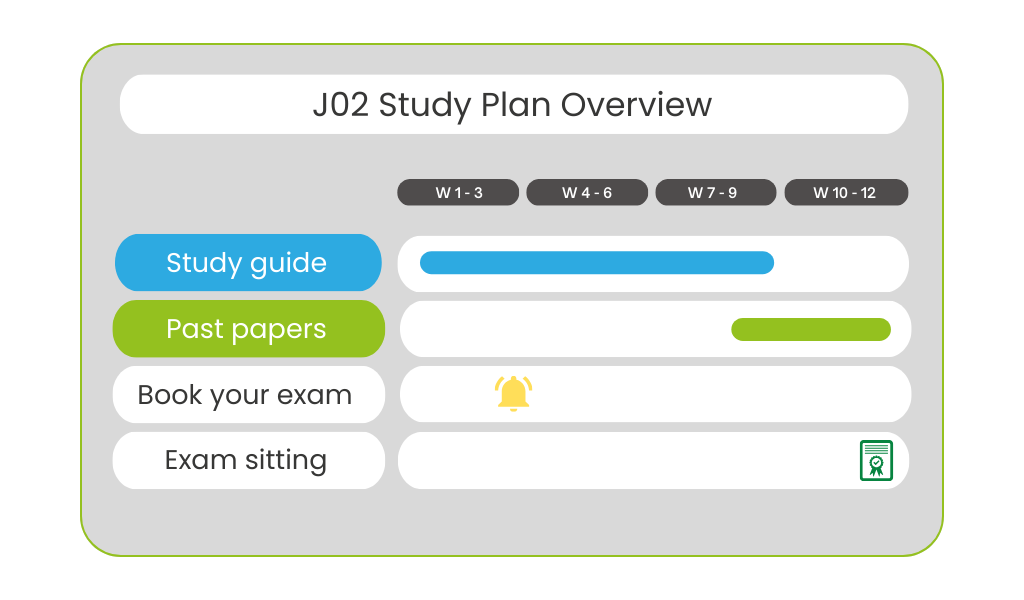
This J02 Study Plan has been designed by the team at BTS.
Our highly-qualified and experienced team sit the Chartered Insurance Institute (CII) Level 4 and Level 6 exams annually. This helps to ensure that the materials we produce areas up to date and ‘exam style’ as possible for our customers.
What is the aim of this guide?
As you read each chapter of the guide you will gradually work through the J02 syllabus and practise the necessary exam question answering techniques, using:
Exam bookings are made directly with the CII.
Before booking an exam, candidates must purchase the unit from the CII website.
There is an option to purchase ‘assessment only’ which means just the exam sitting. This allows candidates to purchase study materials elsewhere, e.g. BTS.
Information and guidance on booking and sitting your exam can be found in our Exam FAQs: