Not logged in?
Login / create an account to access free content on the Careers Zone.

BTS-logo-final-CMYK.png

CAREERS ZONE

Failed AF5? How to turn your feedback into gold dust and go again. 

If you’ve recently received your AF5 result and it didn’t go the way you hoped, you’re not alone. AF5 is widely regarded as one of the most challenging exams in the Advanced Diploma, not because of the technical content, but because of how it’s assessed. 

This article will help you understand why candidates fall short in AF5, what the examiner is really looking for, and how to adjust your approach to pass next time. 

First, Understand What AF5 Is Really Testing

Before diving into specific feedback, it’s worth resetting your mindset. 

AF5 is not about recalling facts and listing generic knowledge. 

It is about applying knowledge to a specific client scenario, following the financial planning process and explaining, justifying and tailoring your answers. 

Failed AF5 How to turn your feedback into gold dust and go again. 

The examiner explicitly highlights that success in AF5 depends on demonstrating: 

  • Fact-finding skills 
  • Risk identification 
  • Analysis of client circumstances 
  • Evaluation of options 
  • Clear, justified recommendations 


In simple terms: knowledge gets you started, but application gets you the marks. 

4 Ways Candidates Go Wrong:

Reviewing recent examiner feedback, we can see there’s a consistent pattern across weaker answers:

Failed AF5 How to turn your feedback into gold dust and go again.

1. Not Enough Detail

Many candidates identified the right areas but didn’t go far enough. 

For example: 

  • Mentioning “tax efficiency” without explaining how 
  • Recommending an action without justifying why it’s suitable 


In AF5, a correct point without explanation often gets only partial credit. 

2. Not Linking Back to the Client

AF5 is built around a fact find. Every answer should relate back to it. 

Common issues include: 

  • Generic answers not tailored to the client 
  • Missing key client-specific factors (income level, tax position, retirement stage) 


The examiner expects answers that clearly demonstrate: “This is relevant to this client, because…” 

3. Missing Key Technical Triggers

In several tasks, marks were lost because candidates didn’t spot critical technical points, such as: 

  • Loss of Personal Allowance when income exceeds a certain threshold 
  • The effective tax rate in that band 
  • Money Purchase Annual Allowance (MPAA) rules and reporting requirements 
  • State Pension deferral implications 


These are high-value, repeat-tested concepts in AF5. 

Failed AF5 How to turn your feedback into gold dust and go again.

4. Not Covering Enough Points

AF5 is a marks-per-point exam. 

If a question is worth 10 marks, you typically need around 10–12 distinct, valid points. 

The feedback highlights repeated missed opportunities where candidates: 

  • Gave too few answers 
  • Repeated similar ideas 
  • Failed to expand into multiple angles (tax, risk, suitability, timing, etc.) 


Think breadth as well as depth. 

Five Steps To Improve Your AF5 Technique:

1. Use a Structured Answer Approach

For most questions, aim to follow a structure like: 

  • Identify the issue 
  • Explain what it means 
  • Link it to the client 
  • State the implication or recommendation 

2. Always Justify Recommendations

A recommendation without justification is incomplete. 

Instead of: 

“They should use ISAs” 

Say: 

“They should use ISAs to provide tax-free income and growth, which is particularly beneficial given their higher-rate tax position.” 

3. Think in “Mark Blocks”

For each question: 

  • Count the marks 
  • Aim for at least that many distinct points 
  • Use bullet points if needed 


This ensures you don’t leave marks behind. 

Failed AF5 How to turn your feedback into gold dust and go again.

4. Be Specific, Not General

Avoid vague wording like: 

  • “Improve tax efficiency” 
  • “Consider investments” 


Instead, be precise: 

  • “Deferring State Pension would avoid a 40% tax charge and potential loss of Personal Allowance” 

5. Practise Under Exam Conditions

The examiner strongly encourages: 

  • Attempting past papers without looking at solutions 
  • Timing yourself 
  • Comparing your answers afterwards 


This is one of the fastest ways to improve performance. 

Final Thought: You’re Closer Than You Think

One of the most encouraging points in a recent examiner report was:

Many candidates “identified the right issues but failed to give sufficient detail.”  

That means: 

  • Candidates’ underlying knowledge is likely good 
  • Exam technique is the key gap 


And exam technique can be fixed quickly with the right focus. 

Your Next Step

If you’re preparing for your AF5 resit, focus on: 

  • Practising application (not just revision) 
  • Developing structured, client-linked answers 
  • Expanding your answers to maximise marks 


With the right adjustments, AF5 is absolutely passable. 

WHERE CAN I FIND OUT MORE?

  • View Our AF5 Exam Study Support toolkit to purchase any AF5 Study support including Study Guides, e-Learning modules and online workshops and Free Samples of Study Materials to try before you buy. 


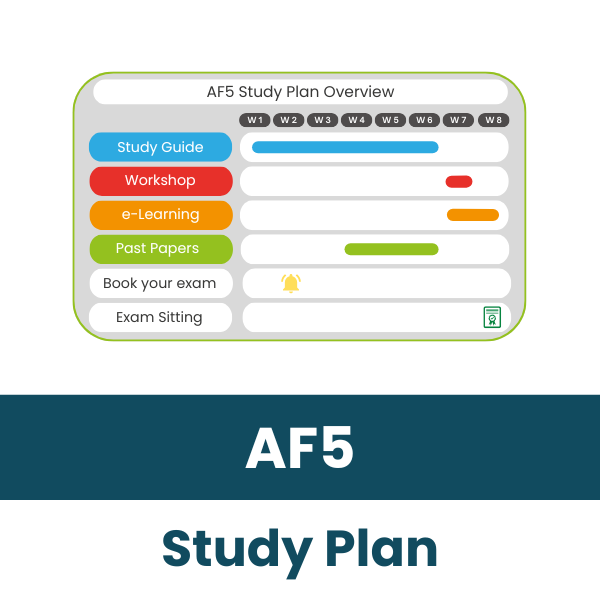
  • Find out more in depth help and advise to structure your AF5 studies by viewing our AF5 Study Plan.


  • To learn more about recovering from a Financial Services exam fail and preparing for your next attempt, read our article: “Failed R06? How to Reset, Refocus and come back Stronger”
To view Careers Zone Content, Please sign in or Register
BTS-logo-final-CMYK.png

Sign in to Careers Zone

BTS-logo-final-CMYK.png

Register for Careers Zone